
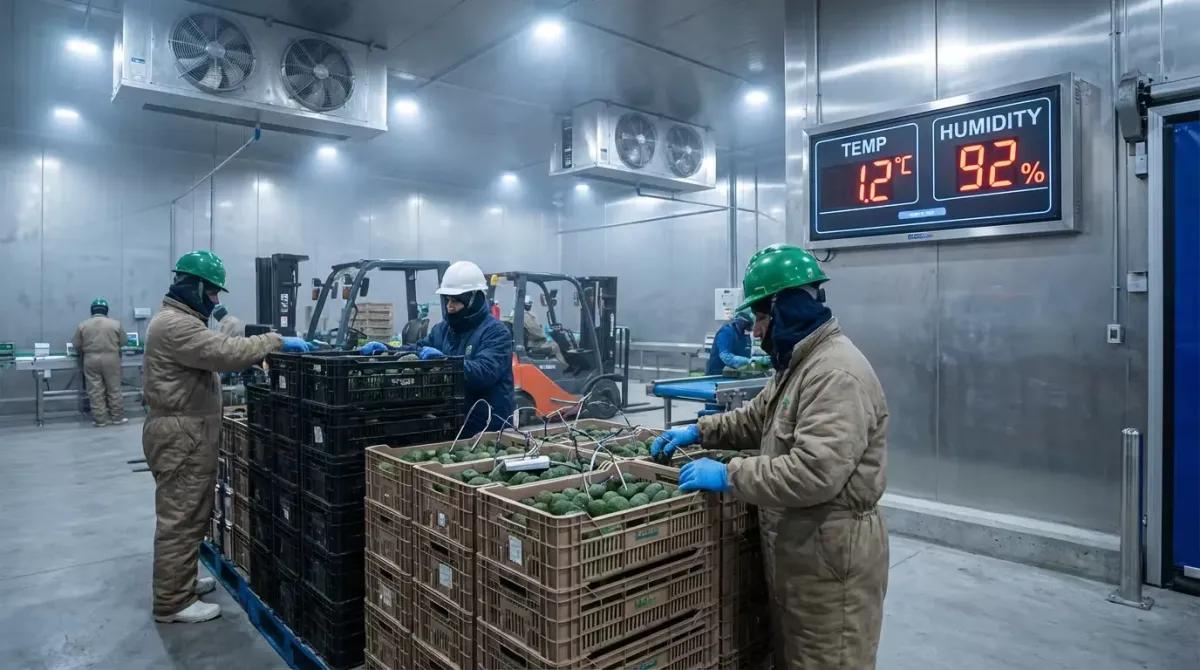
Physiology of Ripeness and Storage
Avocados are climacteric fruit: they continue ripening after harvest. Ripening is governed by temperature (rate doubles every 10°C temperature increase). At 25°C, avocados ripen and soften within 5-6 days. At 10°C, ripening extends to 2-3 weeks. At 0°C, ripening virtually stops (dormancy). Shelf life at retail (18-22°C) depends entirely on initial temperature management: fruit that entered cold chain at 8°C immediately has 25-35 day shelf life; fruit at 15°C has 15-20 days; fruit at 20°C has 10-12 days. Temperature control is not quality luxury -- it is operational necessity.
Critical Control Points
Point 1: Harvest to cooling (0-4 hours). Fruit heated by sun can be 35-40°C at harvest. Without immediate cooling, all subsequent temperature control is compromised. Action: harvest in shade/early morning, place in shade immediately after harvest, transport to cooling facility in insulated container. Point 2: Pre-cooling to 8°C (4-12 hours max). Temperature must drop from harvest temperature to 8°C before pack house. Delay increases losses. Infrastructure: passive cooling (evaporative, low cost), room cooling (mechanical, expensive, fast), or tunnel cooling (compromise, medium cost). Point 3: Pack house operations (2-4 hours). Minimize time outside cold environment. Action: pre-cool fruit before entering pack house, keep pack house doors closed except during fruit movement, pack fruit directly into reefer containers if possible. Point 4: Reefer container transport (0-50 days). Maintain 8-10°C throughout journey. Action: verify reefer function before loading, record temperature data, establish temperature alarm protocols, monitor port dwell time (unplugged containers warm quickly).
Cooling Technology Options
Passive evaporative cooling: cost USD 2,000-5,000, cooling capacity 5-8°C below ambient, slow (6-12 hours to cool), works in dry climate. Use: small cooperatives, budget-constrained, non-perishable crops. Mechanical room cooling: cost USD 15,000-40,000, rapid cooling (2-4 hours), precise temperature maintenance, high operating cost (electricity). Use: high-volume operations, long-term storage, critical perishables. Forced-air coolers (tunnel): cost USD 8,000-20,000, rapid partial cooling (4-6°C reduction), moderate operating cost, suitable for batch cooling before transport. Use: pack houses integrating cooling as intermediate step.
Monitoring and Documentation
Passive temperature loggers (non-electronic): cost USD 3-10 per unit, record min/max temperature during shipment, read after arrival, provides retroactive evidence of cold chain integrity. Use: cost-sensitive, volume shippers, retroactive verification. IoT data loggers: cost USD 15-50 per unit plus cloud platform, provide real-time temperature alerts, continuous monitoring, enable corrective action during shipment. Use: high-value shipments, buyer requirements for real-time data, repeated routes. Technology selection depends on shipment value and buyer requirements: multi-week ocean voyage justifies IoT; air shipment requires passive logger minimum.
Facility and Equipment Maintenance
Cold room pre-season inspection: check mechanical function, verify insulation integrity, test temperature sensors, clean vents and filters. Reefer unit inspection: test coolant levels, check compressor function, verify temperature control accuracy, establish maintenance schedule with shipping company. Facility management: staff training on door discipline (minimize opening time), regular cleaning preventing microbial growth, contingency protocols for equipment failure (backup storage, alternative transport arrangements).
Operational Discipline
Staff training mandatory for all personnel interfacing with cold chain: refrigeration operators, pack house supervisors, warehouse managers. Topics: temperature importance and physiology, equipment operation and troubleshooting, documentation requirements, emergency procedures. Frequency: initial training plus quarterly refresher. Verification: mystery shoppers or auditors randomly check compliance (doors unlocked, temperature records maintained, equipment functioning). Accountability: tie staff bonuses to cold chain performance metrics (zero temperature excursions, target shelf life achieved).
Implementation Recommendations
Start with passive loggers deployed in harvest trucks, cold rooms, and export containers to baseline current temperature profiles. Identify failure points where temperatures regularly exceed 8°C. Invest in pre-cooling infrastructure (highest impact intervention -- properly pre-cooled fruit tolerates downstream excursions better). Implement equipment maintenance schedules for cold rooms and reefer units preventing failures. Upgrade to IoT sensors for high-value or long-voyage shipments once baseline control is proven. Link temperature data to traceability systems creating comprehensive quality documentation supporting premium pricing and buyer confidence.