
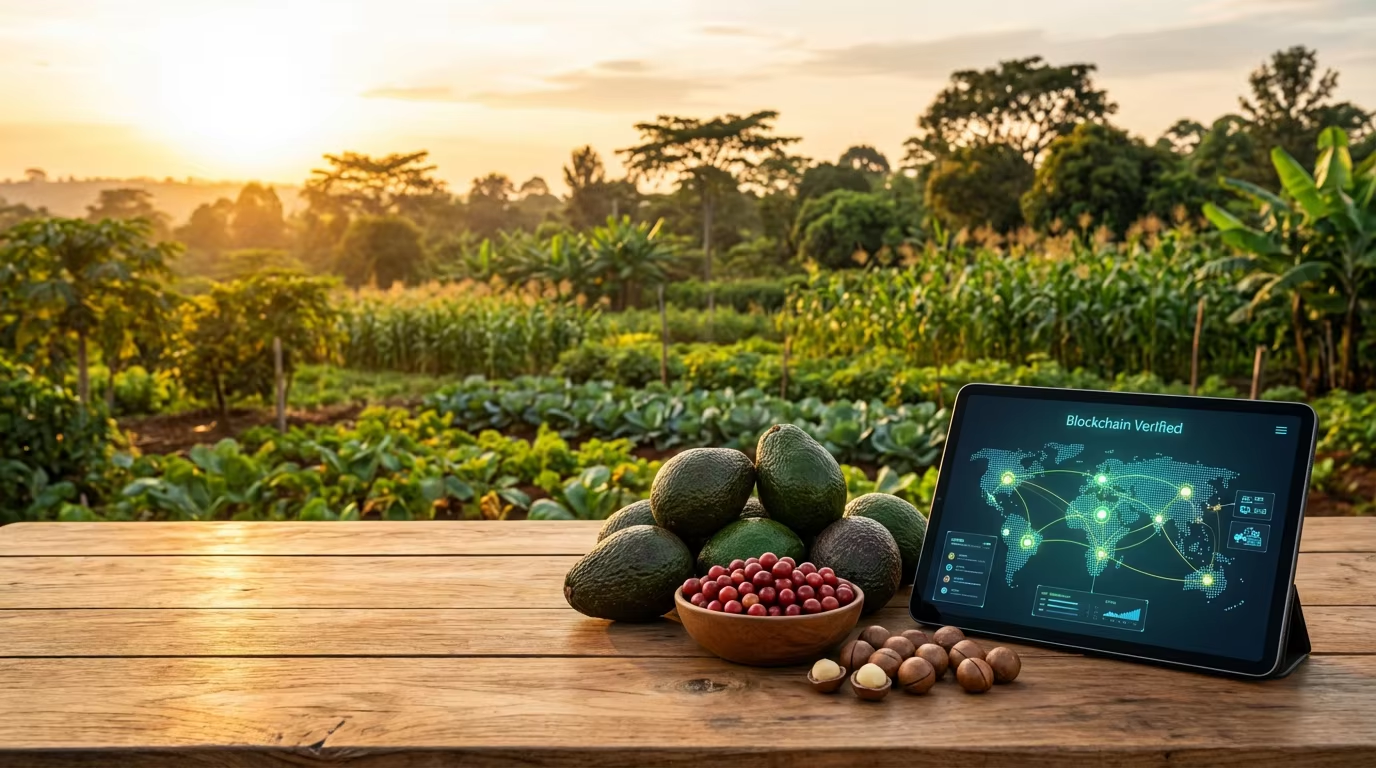
EUDR Compliance — What Every Agrifood Operator Must Know
The EU Deforestation Regulation reshapes how commodities enter European markets. Understand your obligations and how digital traceability makes compliance achievable.
What Is the EU Deforestation Regulation?
The EU Deforestation Regulation (EUDR) — Regulation (EU) 2023/1115 — is a landmark piece of European legislation designed to ensure that specific commodities and products sold or exported from the EU have not contributed to deforestation or forest degradation anywhere in the world.
It represents a fundamental shift: the burden of proof now falls on operators and traders to demonstrate that their supply chains are deforestation-free and legally produced — not on governments or consumers to detect violations.
For agrifood supply chains involving products like cattle, cocoa, coffee, palm oil, soya, wood, rubber, and derived products, EUDR compliance is no longer optional. It is a market access requirement for the EU — the world's second-largest trading bloc.
Who Does EUDR Apply To?
Operators
Any business that places relevant commodities or derived products on the EU market for the first time, or exports them from the EU. This includes importers, processors, and large-scale agricultural enterprises.
Traders
Any business in the supply chain that makes products available on the EU market without being the first placer. Large traders carry the same due diligence obligations as operators; SME traders have simplified reporting requirements.
Exporters & Cooperatives
Agricultural cooperatives and exporters in producing countries — including in Africa — must provide farm-level geolocation data and compliance documentation to their EU buyers. Without this, market access is closed.
The Core Requirements of EUDR
Due Diligence Statements
Before placing a product on the EU market, operators must submit a due diligence statement through the EU's information system. This statement declares that the product is deforestation-free, legally produced, and that a full due diligence process has been carried out. This is a legal declaration — false statements carry serious penalties.
Farm-Level Geolocation Data
The regulation requires geolocation coordinates (latitude and longitude polygons or points) for every plot of land where the commodity was produced. This data must be collected at the source — meaning cooperatives and aggregators must work directly with smallholder farmers to map their plots accurately. Aggregate or approximate locations are not sufficient.
Supply Chain Traceability
Every shipment must be traceable from the farm of origin all the way to the point of sale or export. This requires documented records at each stage of the supply chain — from farm collection, aggregation at cooperative level, processing, transport, and export. The chain of custody must be unbroken and verifiable.
Legal Compliance in the Country of Production
Products must have been produced in compliance with the laws of the country of production — including land use rights, environmental regulations, labour laws, human rights, and the rights of indigenous peoples. Operators must keep documentation proving this compliance for a minimum of 5 years.
Risk Assessment & Risk Mitigation
When due diligence reveals that there is a non-negligible risk that a product does not meet EUDR requirements, operators must implement risk mitigation measures — such as independent audits, satellite monitoring, or requiring additional documentation — before the product can enter the EU market. The regulation follows a tiered country benchmarking system that classifies countries as low, standard, or high risk.
EUDR Covered Commodities
Products regulated under Regulation (EU) 2023/1115
Cattle
Beef, leather, hides
Cocoa
Chocolate, cocoa powder
Coffee
All coffee products
Palm Oil
Oil, derivatives
Soya
Soy products, animal feed
Wood
Timber, paper, furniture
Rubber
Latex, tyres, gloves
Derived Products
All processed derivatives
The Real Challenge: Smallholder Farmers
The greatest challenge EUDR poses is not at the corporate level — it is at the farm level. Millions of smallholder farmers in Africa, Latin America, and Southeast Asia produce the commodities covered by EUDR. Most of them:
- ✕ Have never had their land formally geomapped
- ✕ Lack formal land titling or ownership documentation
- ✕ Are not registered in any digital agricultural system
- ✕ Sell through informal aggregation chains with no audit trail
Without systematic data collection at the farmer level, cooperatives and exporters cannot produce the compliance documentation that EU buyers require. This risks excluding smallholders from lucrative EU markets entirely — the opposite of what the regulation intends.
The solution is digital infrastructure: farmer registration, plot mapping, and verifiable supply chain data, managed at the cooperative level.
How Digital Traceability Enables EUDR Compliance
Farmer & Plot Registration
Digital platforms capture complete farmer profiles alongside GPS-mapped plot boundaries at the point of field data collection. This creates the foundational geolocation record that EUDR requires.
Satellite-Backed Deforestation Checks
Geolocation data feeds into satellite monitoring tools that verify plot land-use status against the January 1, 2021 EUDR cut-off date. This provides automated, verifiable proof that land was not forested at the regulation's baseline.
Digital Chain of Custody
Every harvest, delivery, aggregation, and processing record is captured digitally and linked back to specific farmers and plots. This creates an unbroken, auditable chain of custody from farm to export — exactly what regulators and EU buyers need to verify.
Compliance Documentation & Reporting
Operators can generate due diligence documentation and structured reports directly from the platform, significantly reducing the administrative burden of EUDR compliance and enabling fast, accurate submissions to the EU information system.
Penalties for Non-Compliance
The EUDR carries significant penalties for operators and traders who fail to comply:
Fines of at least 4% of total annual EU-wide turnover in the year preceding the infringement
Confiscation of the products and any revenues derived from those products
Temporary exclusion from public procurement processes and access to public funding
Prohibition from placing relevant commodities on the EU market
Enforcement is carried out by competent authorities in each EU member state, with at least 9% of operators subject to checks annually for high-risk countries.